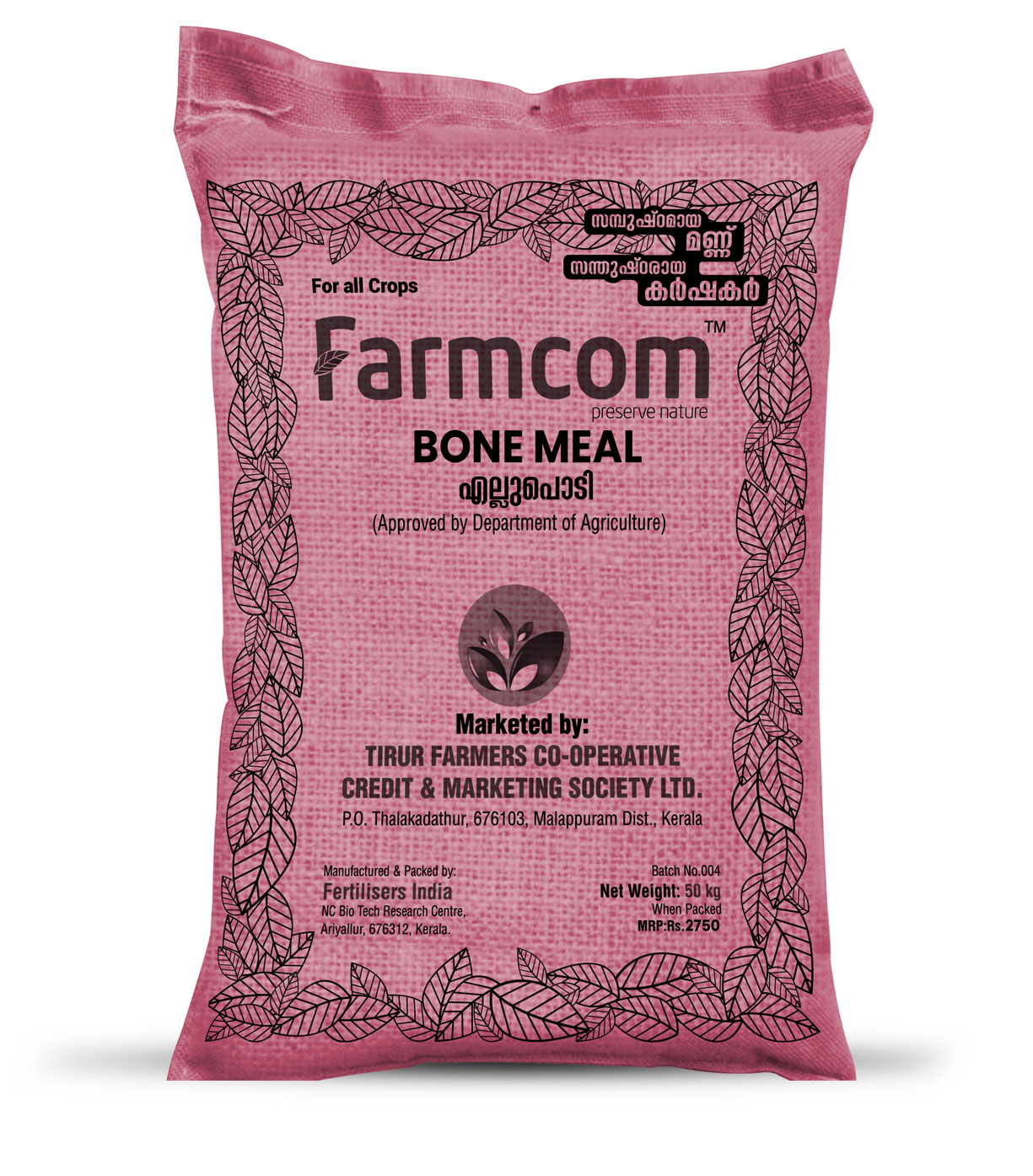
Bone Meal
Standard quality assured product, releases nutrients steadily over an extended period (usually over 3 to 4 months), reducing the need for constant reapplication.
Standard quality assured product, releases nutrients steadily over an extended period (usually over 3 to 4 months), reducing the need for constant reapplication.
Bone Meal: Standard and assured quality of product absorbs slowly.
All the four products are available in 50Kg bags and in 2 Kg Bags
To apply bone meal effectively, mix it thoroughly into the soil and water the area immediately. Because bone meal is a slow-release fertilizer high in phosphorus and calcium, it works best when it comes into direct contact with the root zone.
| Coconut Palms | > Apply 1 to 2 kg per palm annually. > Dig a circular trench 1.5 meters away from the trunk. > Mix bone meal with topsoil inside the trench. > Cover the trench and water heavily |
| Arecanut Palms | > Apply 500 grams per palm every year. > Scatter it in a 1-meter radius around the base. > Fork it lightly into the soil. > Apply during the post-monsoon season |
| Black Pepper Vines | > Apply 200 to 250 grams per vine annually. > Apply at the base of the support tree. > Keep fertilizer 30 cm away from the main stem. > Incorporate gently to avoid damaging surface roots. |
| Gardens & Vegetables | > Apply 50 to 100 grams per square meter. > Broadcast evenly across the bed during soil preparation. > Mix it into the top 6 inches of soil. > For transplants, add 1 tablespoon directly to the hole. |
| Flower Gardens | > Apply 100 grams per square meter in spring. > For rose bushes, use 1 cup per shrub. > Work it gently into the soil around the drip line. > Water thoroughly to trigger the slow-release process. |
Bone meal behaves differently depending on the soil structure and PH. Since bone meal primarily provides phosphorus and calcium, these nutrients can easily become locked up or wasted in acidic, clay, or sandy soils if not managed correctly.
Acidic Soil: In acidic soils (pH below 6.0), bone meal dissolves faster because of the acidity. However, if the soil is too acidic (pH below 5.5), the dissolved phosphorus quickly bonds with iron and aluminium in the soil, making it permanently unavailable to plants
| Correct the pH first | If the soil is highly acidic, apply lime or dolomite 2 to 3 weeks before adding bone meal to bring the pH closer to 6.5. |
| Band or pocket application | Do not broadcast bone meal widely. Place it in concentrated bands or specific planting holes near the roots. This reduces the contact area between the fertilizer and the acidic soil, preventing nutrient fixation. |
| Mix with compost: | Always mix bone meal with well-rotted manure or compost. Organic matter acts as a buffer, shielding the phosphorus from locking up with iron and aluminium. |
Clay Soil: Clay soil has tightly packed particles with poor aeration. Because water and air move slowly through clay, bone meal breaks down much slower, and the nutrients struggle to migrate down to the root zone.
| Deep incorporation: | Do not leave bone meal on the surface. Till or dig the soil deeply, mixing the bone meal 15 to 20 cm (6 to 8 inches) deep right where the roots grow. |
| Aerate the soil: | Combine the bone meal application with soil-loosening materials like coarse sand, rice husks, or coco peat to improve drainage and help microbial activity break down the meal. |
| Apply early: | Since breakdown is slow in heavy clay, apply it 3 to 4 weeks before the peak growing season or heavy monsoon rains. |
Sandy Soil: Sandy soil drains rapidly and has a very low capacity to hold nutrients. While bone meal is slow-release, its nutrients can still leach away from the root zone during heavy rains or watering.
| Split the dosage: | Instead of applying the full amount once a year, split it into 2 or 3 smaller applications throughout the year to prevent leaching. |
| The "Sponge" technique: | Mix bone meal heavily with biochar, vermicompost, or rich organic mulch. This organic matter acts like a sponge, holding onto the calcium and phosphorus as they release |
| Mulch the top | Always apply a layer of leaf mulch or straw over the fertilized sandy soil to retain moisture. Bone meal requires consistent soil moisture and soil microbes to break down |
Access with compost/manure, is the perfect tool to maximize the efficiency of bone meal. Organic matter acts as a bridge, preventing nutrient lock-up in clay or acidic soil and stopping nutrient leaching in sandy soil.
Coconut & Arecanut Palms:
Palms require deep nutrient placement and sustained moisture to absorb phosphorus and calcium effectively.
| In Acidic Soil: | Mix the required dose of bone meal (2 kg for coconut, 500g for arecanut) with 10–15 kg of compost/manure per palm. Dig a circular trench 1.5 meters away from the trunk. Dust the trench lightly with 500g of agricultural lime first to counter acidity, wait a week if possible, then apply bone meal-compost blend and cover. |
| In Clay Soil: | Dig the trench slightly wider. Mix the bone meal and manure with a few spades of coarse sand or coir pith. This loosens the clay, brings in air, and allows the soil microbes to break down the bone meal. |
| In Sandy Soil: | Split the annual bone meal dose into two applications (e.g., pre-monsoon and post-monsoon). Mix each half-dose with a very generous amount of manure (15–20 kg). Apply in the root zone and heavily mulch the surface with coconut husks or dry leaves to trap moisture |
Black Pepper Vines:
Pepper vines have sensitive surface feeder roots. Care must be taken not to damage them while ensuring the fertilizer is accessible.
| In Acidic Soil: | Mix 200g of bone meal with 5 kg of well-rotted manure and a handful of wood ash (which acts as a mild, natural de-acidifier). Apply this blend in a ring 30 cm away from the base of the vine. Keep it concentrated rather than spreading it wide. |
| In Clay Soil: | Never dig deeply around pepper roots in clay, as it causes waterlogging and root rot. Instead, gently scrape the top 5 cm of soil 30 cm away from the vine. Mix the bone meal with compost and coco peat, lay it down, and cover it back up lightly |
| In Sandy Soil: | Apply 100g of bone meal mixed with 5 kg of manure twice a year. Sand drains too fast for a single heavy dose. Top the area with a thick layer of green mulch to prevent the nutrients from washing straight down past the roots. |
Vegetable Gardens:
Vegetables are fast growers and need immediate access to nutrients during their short lifecycles.
| In Acidic Soil: | Two weeks before planting, mix dolomite lime into the garden bed. When planting, create a "pocket" of 1 part bone meal to 10 parts compost directly under where the seedling or seed will go. This protects the phosphorus from iron-binding |
| In Clay Soil: | Thoroughly till the vegetable bed, mixing bone meal (100g per sq. meter) and manure deeply down to 20 cm. The manure and bone meal work together over the 3–4 month period to structurally soften the hard clay. |
| In Sandy Soil: | Mix bone meal directly into compost heap a few weeks before planting to "charge" the compost. Apply this enriched compost to your vegetable beds. Water frequently but lightly so you don't flush the nutrients away. |